
Generative AI explained in simple terms begins with understanding what these tools actually do and why they have become so widely used.
But what makes generative AI different from other forms of artificial intelligence? The key difference is in what it produces. Instead of simply analyzing information or making predictions, generative AI can create new content based on patterns it learned during training.
In this lesson, you’ll learn what generative AI is, how it works at a basic level, what it can create, and why understanding its strengths and limitations is becoming increasingly important.
In This Lesson
- What generative AI is and what makes it different
- How generative AI creates new content
- The major types of content generative AI can produce
- How generative AI learns from patterns in data
- Common ways people use generative AI
- The strengths and limitations beginners should understand
Generative AI Explained: What Is Generative AI?
Generative AI is a type of artificial intelligence designed to create new content. That content can include text, images, music, audio, video, computer code, and other forms of digital material.
The word generative comes from the idea of generating, or creating, something new. However, the AI is not creating in exactly the same way a person does. It uses patterns learned from large amounts of training data to produce an output that fits the instructions it receives.
For example, when you ask a generative AI tool to write a product description, it does not simply search for an existing description and copy it. It uses patterns it learned during training to generate a new response based on your request.
How Is Generative AI Different from Traditional AI?
Traditional AI systems are often designed to analyze, classify, predict, or make decisions based on information they receive. For example, an email service might use AI to decide whether a message is spam, while a banking system might use it to identify unusual transactions.
Generative AI goes a step further. Instead of only analyzing existing information, it can produce new content in response to a prompt or instruction.
Think of the difference this way: traditional AI might examine a photograph and identify that it contains a dog. Generative AI can take a request such as “create an illustration of a dog playing in the snow” and generate a new image based on that description.
The two approaches can overlap, but this ability to generate new material is what makes generative AI especially useful for creative, educational, and productivity tasks.
Stroxio’s Insight
Generative AI doesn’t replace everything traditional AI does. Think of it as another capability in the AI toolbox. Some systems analyze information, some make predictions, and generative AI specializes in producing new content from the patterns it has learned.
How Does Generative AI Create Content?
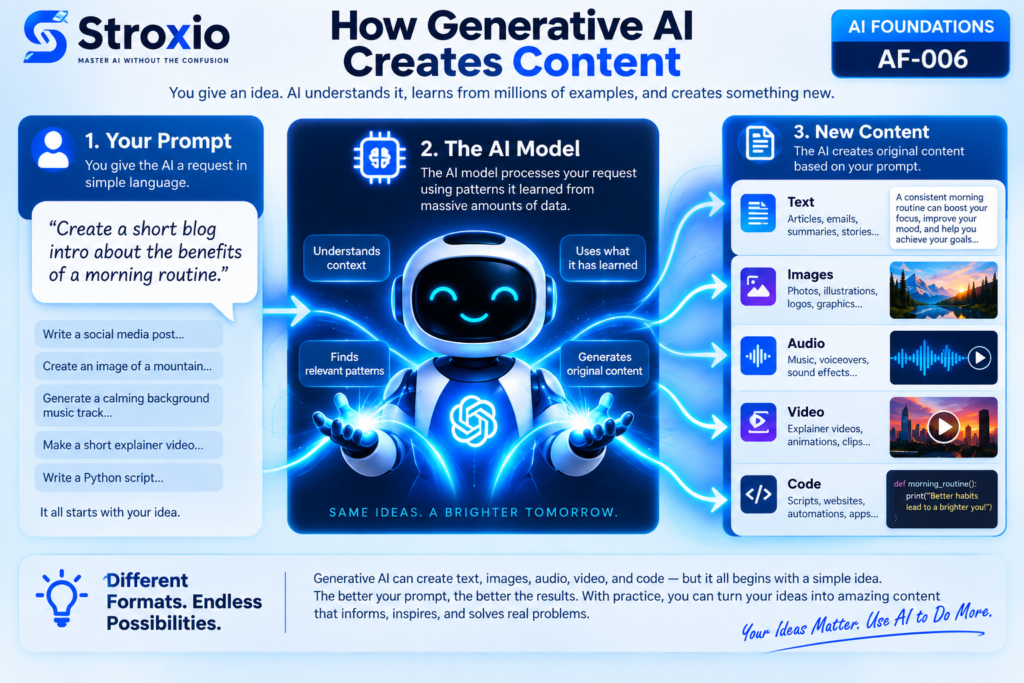
Generative AI explained at a practical level starts with patterns the system learned during training. When you give the system a prompt, it processes your instructions and uses those learned patterns to determine what kind of output would best fit your request.
For text-based AI, this often means predicting which words or pieces of words are likely to come next. For an image generator, it means using learned relationships between visual patterns and written descriptions to construct an image that matches the prompt.
The important point is that generative AI is not simply pulling a finished answer from a database. It is generating an output based on its training, the information available in the current context, and the instructions you provide.
This is also why the same prompt can sometimes produce different results. Generative AI can have more than one reasonable way to respond to the same request.
What Can Generative AI Create?
Generative AI can produce many different types of digital content. The exact capabilities depend on the AI system being used, but some of the most common include:
- Text: articles, emails, summaries, stories, outlines, and answers to questions
- Images: illustrations, concept art, graphics, and other visual content
- Audio: speech, sound effects, and music
- Video: short clips, animations, and AI-generated scenes
- Code: programming examples, explanations, debugging suggestions, and code drafts
Some AI tools specialize in one type of content, while others are multimodal, meaning they can work with more than one form of information, such as text and images.
How People Use Generative AI
Generative AI has moved beyond research labs and into tools that people use for work, education, creativity, and everyday problem-solving. You may already be using generative AI without thinking of it by that name.
A student might use it to explain a difficult concept in simpler language. A small business owner might use it to brainstorm marketing ideas or draft a product description. A programmer might ask for help understanding code, while a designer might use an image generator to explore visual concepts.
Generative AI can also help people summarize information, organize ideas, prepare outlines, create first drafts, translate or rewrite text, and explore different approaches to a problem.
The most useful way to think about these tools is as assistants rather than automatic experts. They can help you work faster and explore possibilities, but their output still requires human judgment.
Stroxio’s Insight
The real value of generative AI isn’t simply that it can create content quickly. Its value comes from how you use that capability. A good AI-generated result can give you a starting point, help you explore an idea, or save time—but your knowledge, judgment, and decisions are still what turn that output into something useful.
The Limitations of Generative AI
Generative AI can produce impressive results, but it does not guarantee that everything it creates is accurate, complete, or appropriate. A response can sound confident and convincing while still containing mistakes.
AI systems can misunderstand a prompt, leave out important context, produce outdated information, or generate details that are not true. As you learned in AF-005, confidently generated false or misleading information is often described as an AI hallucination.
Generative AI also does not possess human judgment, personal experience, or an automatic understanding of whether a particular answer is suitable for your situation.
For that reason, important information should be checked against reliable sources—especially when it involves health, finances, legal matters, safety, or other high-stakes decisions.
Using Generative AI Responsibly
Using generative AI responsibly means understanding that you remain responsible for how you use its output. AI can assist with the work, but it should not automatically make important decisions for you.
Before using AI-generated information, consider whether the facts need to be verified. Review generated content for errors, misleading statements, inappropriate material, or information that may not fit the situation.
You should also be careful about the information you provide to an AI system. Avoid entering passwords, financial account details, confidential business information, or other sensitive personal data unless you understand how the particular service handles that information.
The goal is not to distrust generative AI. It is to use it with awareness, verification, and human judgment.
Putting Generative AI Together
Think of generative AI as a highly capable pattern-based assistant. You give it instructions through a prompt, it uses patterns learned during training along with the available context, and it generates a response that attempts to match what you asked for.
A simple way to picture the process is:
Your Prompt → AI Model → Generated Content → Your Review
The final step—Your Review—is just as important as the others. Generative AI can produce the content, but you decide whether that content is accurate, useful, appropriate, and ready to use.
Stroxio’s Insight
Generative AI becomes much more useful when you stop thinking of its first response as the finished product. Treat the output as something you can review, question, refine, and improve. The strongest results often come from working with AI through several rounds rather than accepting the first answer it gives you.
Stroxio Challenge: Put Generative AI to Work
Choose a generative AI tool you already have access to and give it one simple task. You might ask it to explain a topic, brainstorm several ideas, draft a short paragraph, or create something based on your instructions.
After you receive the first response, don’t stop there. Ask the AI to improve or change one part of its answer. For example, you could ask it to make the response shorter, clearer, more detailed, or easier for a beginner to understand.
Then compare the first and second responses. Notice how your additional instruction changed the result.
The goal of this challenge is simple: experience firsthand that generative AI works best as an interactive process, not just a one-question, one-answer tool.
Key Takeaways
- Generative AI creates new content such as text, images, audio, video, and code.
- It generates content using patterns learned during training, rather than simply retrieving a finished answer.
- Generative AI can help with learning, creativity, productivity, brainstorming, and problem-solving.
- AI-generated content can contain errors or hallucinations, even when it sounds convincing.
- Responsible use requires verification, awareness, and human judgment.
- Better results often come from reviewing and refining AI-generated responses instead of accepting the first output.
Want to understand the language behind generative AI? Explore our beginner-friendly guide, AI Terms Every Beginner Should Know, to learn essential AI terminology through simple explanations and practical examples.
Lesson Complete
You now understand what generative AI is, how it creates content, and why it has become such an important part of modern artificial intelligence.
You’ve also learned something equally important: generative AI is most useful when its output is combined with human review, verification, and judgment.
As you continue through AI Foundations, these ideas will help you better understand the technologies behind the AI tools you encounter and use.
Continue Your Journey
You now understand how generative AI can create new content using patterns learned during training. Next, we’ll look more closely at one of the technologies that helps make many modern AI systems possible: machine learning.
Your next lesson is:
Machine Learning Explained Simply
In the next lesson, you’ll learn what machine learning is, how it allows AI systems to learn patterns from data, and why it plays such an important role in many of the AI tools and technologies you use today.
One lesson. One challenge. One step forward.