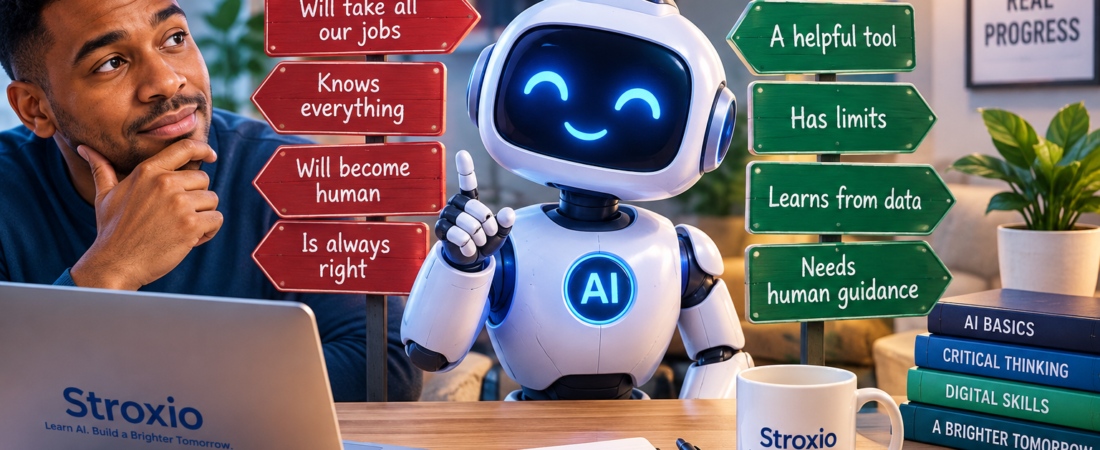
AI myths explained clearly can help beginners separate facts from exaggeration. Artificial intelligence is surrounded by big claims, bold predictions, and plenty of misunderstandings.. If you are new to AI, it can be difficult to separate what these systems can actually do from what movies, headlines, and social media sometimes make them seem capable of doing.
Some people believe AI can think exactly like a human. Others assume it knows everything, never makes mistakes, or will eventually replace every job. These ideas can make AI seem either far more powerful—or far more frightening—than it really is.
In this lesson, we’ll examine seven common AI myths and uncover what is really happening behind them. By the end, you’ll have a clearer and more realistic understanding of what today’s AI can do, where its limitations are, and why knowing the difference matters when you use it.
Myth #1: AI Thinks – Like a Human
One of the most common misconceptions about artificial intelligence is that it thinks the same way people do. Because an AI can answer questions, carry on a conversation, and produce surprisingly natural responses, it can sometimes feel as though there is a human-like mind behind the screen.
But that is not how today’s AI works.
AI systems process information and recognize patterns in data. A language model, for example, generates responses by identifying relationships between words and predicting what should come next based on patterns learned during training. It can produce an answer that sounds thoughtful without experiencing thoughts in the human sense.
If you’d like a refresher on what happens behind the scenes, see our earlier lesson, How AI Models Work: A Beginner’s Guide to Understanding Artificial Intelligence.
Humans bring consciousness, emotions, personal experiences, values, and an understanding of the physical world to their decisions. AI does not experience the world in that way.
The reality: AI can imitate some aspects of human communication and reasoning remarkably well, but sounding human and thinking like a human are not the same thing.
Stroxio’s Insight
When AI sounds confident, friendly, or thoughtful, it is easy to imagine that it understands a conversation exactly as a person would. A better habit is to focus on what the AI is doing, not what it appears to be feeling or thinking.
Think of AI as a highly capable pattern-processing tool—not a human mind inside a computer.
Myth #2: AI Knows Everything
AI can answer questions about an enormous range of subjects, which can make it seem as though it has an unlimited store of knowledge. Ask about history, business, technology, cooking, or science, and you may receive a detailed answer within seconds.
But AI does not know everything.
An AI model is limited by the information it was trained on, the tools and information it can access, and the way it interprets your request. It may not have access to current information unless it is connected to tools that can retrieve it.
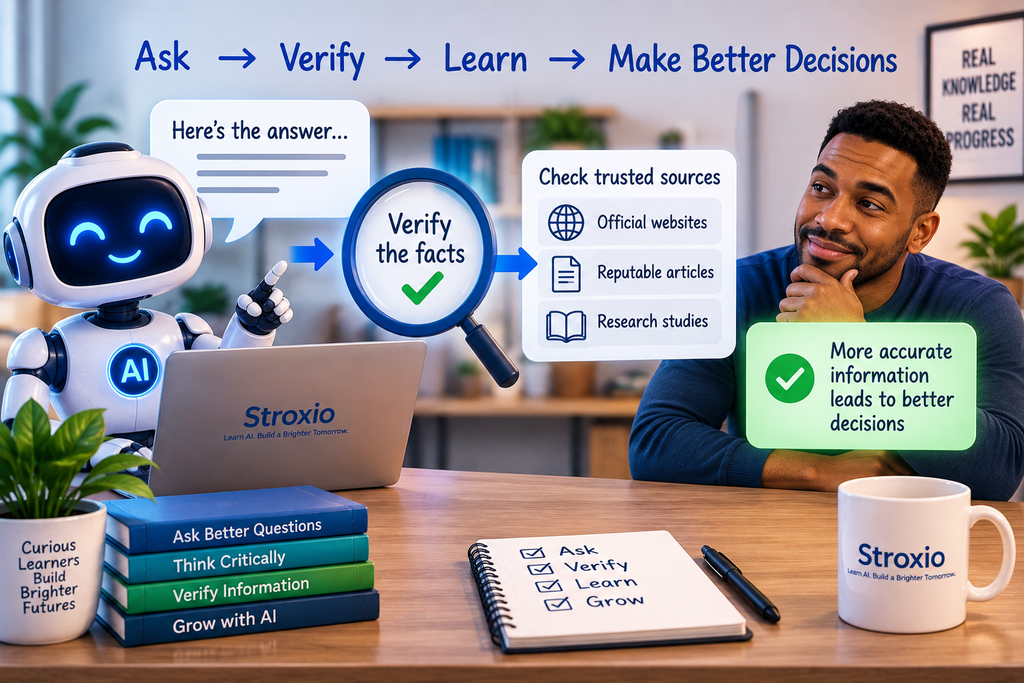
More importantly, AI can sometimes produce information that sounds convincing but is incomplete, outdated, or simply incorrect. This is one reason important facts should be verified rather than accepted only because an AI presented them confidently.
The reality: AI can provide access to an extraordinary range of information, but it should never be treated as an all-knowing source.
Myth #3: AI Is Always Accurate
AI can produce polished answers so quickly that it is tempting to assume the information must be correct. A well-written response with specific details can appear especially trustworthy.
However, a confident answer is not the same as an accurate answer.
AI systems can misunderstand a question, rely on incomplete information, or generate details that are not supported by reliable evidence. These incorrect but convincing responses are sometimes called AI hallucinations.
This is why human judgment remains important. If you are using AI for something that could affect your health, finances, legal decisions, education, or business, important information should be checked against reliable sources.
The reality: AI can be extremely useful, but its answers should be evaluated rather than automatically accepted as fact.
Myth #4: AI Will Replace Every Human Job
Few AI myths receive more attention than the idea that artificial intelligence will eventually replace everyone at work. AI is already changing how many jobs are performed, so it is understandable that people are concerned about what comes next.
But changing jobs is not the same as eliminating every job.
AI is particularly effective at automating certain repetitive, predictable, or data-heavy tasks. In many occupations, however, people perform a combination of tasks that also require judgment, creativity, communication, responsibility, physical skills, or an understanding of other people.
This means AI is more likely to change how many people work than simply make human workers unnecessary. Some tasks will be automated, some jobs will evolve, and new types of work may emerge as organizations adopt new technology.
Learning how to work effectively with AI can therefore become an advantage. Instead of viewing AI only as a competitor, beginners can learn to use it as a tool that helps them research, organize ideas, solve problems, and work more efficiently.
The reality: AI will change the workplace, but that does not mean every human job will disappear.
Stroxio’s Insight
When new technology changes the workplace, the advantage often goes to people who learn how to use it effectively. AI does not have to replace your skills—it can help you extend them.
Instead of asking only, “Will AI replace my job?” consider asking, “Which parts of my work could AI help me do better?” That change in perspective turns uncertainty into an opportunity to learn.
Myth #5: AI Learns Everything You Tell It
When you have a long conversation with an AI and it refers to something you mentioned earlier, it can seem as though the AI is constantly learning from everything you say.
That impression can be misleading.
During a conversation, an AI system may use information from the current chat to understand context and provide more relevant responses. Some AI services may also offer memory or personalization features that can retain certain information between conversations.
But this is different from the AI model instantly retraining itself every time you type a message. Your individual conversation does not automatically rewrite the model or immediately become part of its general knowledge.
This distinction is also a good reason to pay attention to the privacy and data settings of any AI service you use. Different services can handle conversations and stored information differently.
The reality: AI can use conversational context and, in some systems, saved information to personalize responses, but that is not the same as the underlying model learning and retraining itself from every conversation.
Myth #6: Smarter AI Will Eventually Become Human
As AI systems become more capable, it is easy to assume that they are gradually becoming more human. Improvements in conversation, reasoning, image creation, and problem-solving can make this idea seem believable.
But greater capability does not automatically mean greater humanity.
An AI system can become better at completing particular tasks without developing emotions, personal desires, life experiences, or a human identity. A calculator becoming more powerful does not become a mathematician, and an AI becoming more capable does not automatically become a person.
Researchers continue to explore increasingly advanced forms of artificial intelligence, and there are still important questions about what future systems may be able to do. But we should distinguish those possibilities from what today’s AI actually is.
The reality: AI can become increasingly capable without becoming human. Intelligence, capability, consciousness, and human experience are not necessarily the same thing.
Myth #7: AI Is Either Good or Bad
Discussions about artificial intelligence are often presented in extremes. AI is sometimes described as a technology that will solve nearly every problem—or as something that will inevitably cause serious harm.
The reality is more complicated.
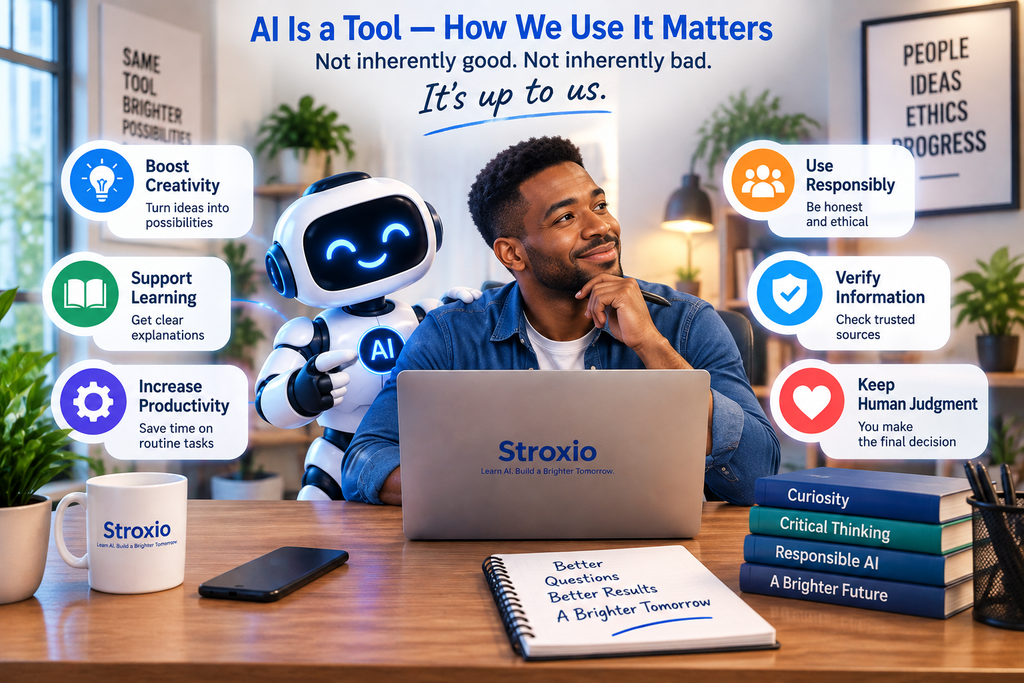
AI is a technology, and its impact depends greatly on how it is designed, used, and managed. The same type of AI that helps someone organize information, learn a new skill, or improve productivity can also produce misleading content or be used irresponsibly.
This is why having AI myths explained clearly matters. The more you know about what these systems can and cannot do, the better prepared you are to use them thoughtfully and recognize situations where extra caution is needed.
You do not need to fear AI, and you should not trust it blindly either. A balanced approach means appreciating what AI can do while remaining aware of its limitations.
The reality: AI is neither automatically good nor automatically bad. How people develop, manage, and use it plays a major role in the results it produces.
Stroxio’s Insight
One of the most useful AI skills is learning to separate capability from appearance. AI can sound certain without being correct, appear thoughtful without thinking like a person, and perform impressive tasks without understanding the world the way you do.
The goal is not to underestimate AI or exaggerate it. The goal is to understand it well enough to use its strengths while recognizing its limitations.
Challenge
Think of one claim about AI that you have heard from a friend, at work, on television, or on social media.
Ask yourself three questions:
1. What exactly is being claimed?
Try to separate the actual statement from any fear, excitement, or exaggeration surrounding it.
2. What evidence supports the claim?
Look for reliable information rather than assuming a confident statement must be true.
3. Does the claim describe what AI can do today—or what someone believes AI might do in the future?
Keeping current capabilities separate from predictions can help you evaluate AI claims more clearly.
You do not need to become an AI expert. The goal is simply to develop the habit of questioning extraordinary claims before accepting them.
AI Myths Explained: Key Takeaways
Understanding AI myths explained in plain language makes it easier to separate what artificial intelligence can actually do from the exaggerated claims that often surround it.
- AI can imitate aspects of human communication, but that does not mean it thinks or experiences the world like a human.
- AI has access to a great deal of information, but it does not know everything and can still produce incorrect answers.
- A confident AI response is not automatically an accurate one, so important information should be verified.
- AI is likely to change many jobs and tasks, but that is different from replacing every human worker.
- Using conversational context or saved information is not the same as an AI model instantly retraining itself from everything you tell it.
- Increasing AI capability does not automatically mean AI is becoming human.
- AI is neither inherently good nor bad. Its impact depends greatly on how people develop, manage, and use it.
Understanding these distinctions gives you something more valuable than either fear or hype: a realistic view of AI and the confidence to use it more wisely.
Want to better understand the AI terminology behind these common misconceptions? Explore our beginner-friendly guide, AI Terms Every Beginner Should Know, for clear explanations of AI models, training, prompts, and other essential concepts.
Lesson Complete
You’ve now explored AI myths explained through seven of the most common misconceptions surrounding artificial intelligence and learned why AI is often misunderstood.
The most important lesson is not that AI should be feared or trusted without question. It is that AI should be understood.
When you recognize the difference between what AI appears to do and what it is actually doing, you can make better decisions about when to use it, when to verify its answers, and when human judgment matters most.
You are building the kind of AI knowledge that helps replace confusion with confidence—and that foundation becomes even more important as we turn to the responsible use of these powerful tools.
Continue Your Journey
You now have a clearer understanding of some of the most common myths surrounding artificial intelligence. You’ve seen why AI can appear more knowledgeable, accurate, or human-like than it really is—and why a balanced understanding matters.
But knowing what AI can and cannot do is only part of becoming a confident AI user. You also need to know how to use these tools safely and responsibly.
Your next lesson is:
AF 009 – AI Safety for Beginners
In the next lesson, you’ll learn practical ways to protect your privacy, recognize potential risks, handle AI-generated information carefully, and develop safer habits when using AI tools.
One lesson. One challenge. One step forward.