
How AI models work can seem complicated when you hear terms like algorithms, machine learning, neural networks, and large language models. But the basic idea behind AI is much easier to understand than the terminology might suggest. Once you understand how AI models work, many of those technical terms begin to make much more sense.
At its core, AI works by using data to identify patterns and then applying those patterns to make predictions, recommendations, decisions, or generate new content. Different AI systems do this in different ways, but they share an important principle: they learn useful relationships from information rather than being manually told how to handle every possible situation.
If you need a quick refresher before continuing, revisit our previous lesson, What Is ChatGPT?, to see how these AI concepts connect to a tool you already know.
In this lesson, we’ll look beneath the surface and explain how AI models works in plain language. You’ll learn the roles of data, training, patterns, models, and predictions—and see how these pieces work together to produce the AI tools you use today.
In This Lesson
By the end of this lesson, you’ll understand:
- How AI learns from data
- What AI training actually means
- How patterns help AI make predictions
- What an AI model is
- The difference between training and using an AI system
- Why AI can produce impressive results and still make mistakes
- How human guidance remains part of the process
AI Starts with Data
Every AI system needs information to work with. That information is called data. Depending on the type of AI, the data might include text, photographs, sounds, numbers, videos, customer activity, weather records, or countless other forms of information.
During training, an AI system examines large amounts of this data looking for relationships and recurring patterns. For example, an image-recognition system might learn which visual patterns are commonly associated with cats, cars, trees, or people. A language model learns patterns in how words, phrases, ideas, and concepts relate to one another.
The quality of the data matters. If training data is incomplete, inaccurate, outdated, or heavily biased in one direction, those weaknesses can influence the AI system built from it.
This is why more data does not automatically mean better AI. The usefulness, diversity, relevance, and quality of that information matter just as much as the amount.
⭐ Stroxio Insight
AI does not become intelligent simply because it receives more information. What matters is whether the system can identify useful patterns within that information. Good data gives AI something valuable to learn from; poor data can teach it the wrong lessons.
What Does “Training” an AI Mean?
When people say an AI system has been “trained,” they do not mean it was taught in the same way a person learns in a classroom. AI training is a mathematical process in which a computer analyzes data and gradually adjusts itself to become better at recognizing patterns or producing useful results.
During training, the system makes predictions, compares those predictions with examples or expected outcomes, and adjusts internal numerical values to reduce its errors. This process may happen millions or even billions of times.
Imagine teaching someone to recognize handwritten numbers. You might show them thousands of examples of 1s, 2s, 3s, and so on. Over time, they begin recognizing the characteristics that distinguish one number from another. AI training follows a very different mathematical process, but the basic idea is similar: repeated exposure to examples helps the system identify useful patterns.
Once training is complete, those learned patterns are stored within what we call a model. The model can then use what it learned to respond to new information it has never encountered in exactly the same form before.
From Patterns to Predictions
Once an AI model has learned patterns during training, it can use those patterns when it receives new information. This is where AI begins doing the work that users actually see.
Suppose an AI system has been trained to recognize spam emails. When a new email arrives, the model examines patterns in the message—such as certain words, phrases, links, and other characteristics—and estimates how likely the message is to be spam.
The same basic principle appears in many forms of AI. A recommendation system predicts which products or videos you may find interesting. An image-recognition system predicts what appears in a photograph. A language model predicts what words or pieces of language are likely to produce a useful response.
This is an important distinction: AI generally works with probabilities and patterns, not human-style certainty. A prediction can be highly likely and still be wrong.
What Is an AI Model?
You will hear the word “model” frequently when people talk about artificial intelligence. An AI model is the trained system that uses patterns learned from data to process new information and produce an output.
Think of training as the learning process and the model as the result of that process. Once trained, the model can be given new input and use what it has learned to generate a prediction, classification, recommendation, or response.
Different models are designed for different purposes. Some recognize objects in images. Others detect unusual financial activity, recommend products, forecast demand, translate languages, or generate text and images.
ChatGPT uses language models designed to work with language. When you enter a prompt, the model processes the context and uses learned patterns to construct a response. It is applying its training rather than searching through a stored collection for one predetermined answer.
Training an AI vs. Using an AI
One of the easiest ways to understand AI is to separate two stages that are often confused: training and using the trained model.
During training, the system processes large amounts of data and adjusts its internal parameters as it learns patterns. This stage can require enormous computing power and may take considerable time.
After training, the model can be used to process new inputs. This stage is often called inference. When you type a prompt into an AI tool and receive a response, you are generally interacting with a trained model during inference—not retraining the entire AI system with every question.
A simple way to remember the difference is:
Training = learning patterns from data
Inference = applying those learned patterns to new input
Understanding this distinction helps explain why an AI system can respond almost instantly even though creating and training the underlying model may have required a massive amount of work beforehand.
⭐ Stroxio Insight
When you use an AI tool, you are usually seeing the result of an enormous amount of training that happened long before you entered your prompt. Your prompt does not teach the entire model from scratch—it gives the trained model context for what you want it to do right now.
Why AI Can Still Get Things Wrong
AI can produce remarkably useful results, but learning patterns from data does not guarantee that every output will be correct. An AI model is still making predictions based on what it learned and the information it receives.
Errors can happen for several reasons. The training data may contain gaps or inaccuracies. A user’s request may be unclear or lack important context. The model may encounter a situation that differs significantly from the patterns it learned during training.
Generative AI introduces another challenge. Because it is designed to generate content, it can sometimes produce information that sounds convincing even when some details are inaccurate or unsupported.
This is why AI output should be treated according to the importance of the task. Brainstorming a birthday-party theme carries very little risk. Making a medical, legal, financial, or safety-related decision carries much greater consequences and requires reliable professional sources and appropriate human judgment.
AI is most useful when we understand both sides of the technology: what it can do well and where human verification still matters.
Why Humans Still Matter
AI can analyze information quickly, recognize patterns across enormous amounts of data, and generate useful results in seconds. But speed and computational power do not replace human judgment.
People still provide the goals, context, values, and responsibility behind how AI is used. We decide what questions to ask, whether an answer makes sense, when information needs verification, and what actions should—or should not—be taken.
This is especially important when an AI system influences decisions involving people. An output may be mathematically reasonable while still overlooking circumstances, fairness, ethics, or consequences that require human consideration.
The strongest approach is not to think of AI as replacing human intelligence. Think of it as a tool that can extend what people are able to analyze, create, and accomplish when it is used thoughtfully.
A Simple Way to Picture How AI Model Work
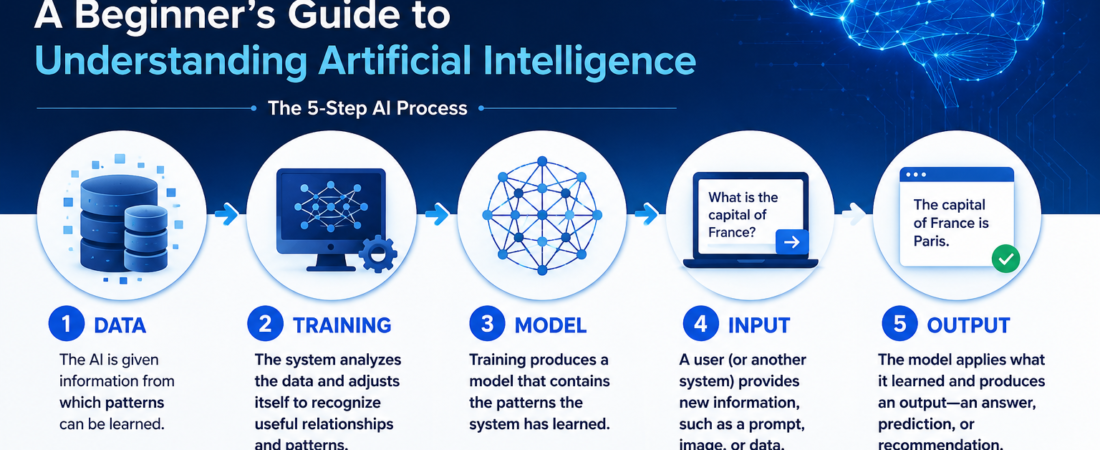
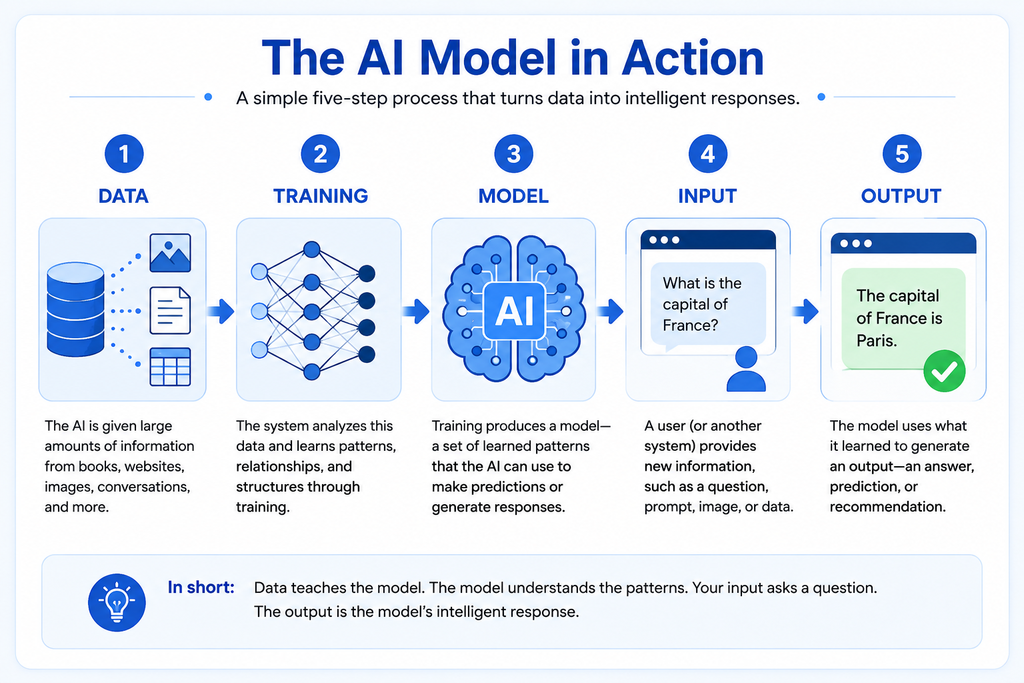
One of the easiest ways to understand how AI models work is to picture the basic process as a simple five-stage flow: This simple five-stage process makes it easier to see how AI models work without getting buried in technical details.
- Data — The AI is given information from which patterns can be learned.
- Training — The system analyzes that data and adjusts itself to recognize useful relationships.
- Model — Training produces a model containing the patterns the system has learned.
- Input — A user or another system provides new information, such as a prompt, image, or set of numbers.
- Output — The model applies its learned patterns to produce a prediction, recommendation, classification, or generated response.
Different AI technologies may use far more complicated processes, but remembering this basic flow—data → training → model → input → output—will give you a useful foundation for understanding what happens behind many AI tools.
⭐ Stroxio Insight
Underneath it, add:You do not need to understand every mathematical detail behind AI to use it effectively. Understanding the basic flow from data to output gives you something more practical: a mental model for judging what AI is doing, what it may be good at, and when its results deserve a closer look.
Common Questions About How AI Works
Does AI actually think like a human?
Not in the human sense. AI processes information using mathematical models and learned patterns. It can produce results that appear intelligent without experiencing thoughts, emotions, or understanding in the way people do.
Does AI remember everything it was trained on?
No. Training does not simply create a searchable copy of every piece of training data. The model learns statistical patterns and relationships that help it process new inputs and generate outputs.
Does an AI learn every time I use it?
Not necessarily. Using a trained model is generally different from training it. Some AI services may use feedback or permitted interactions to improve future systems, but your individual prompt does not normally retrain the entire model instantly.
Why do different AI tools give different answers?
They may use different models, training methods, data, system instructions, settings, and tools. Even the same model can sometimes produce different responses because generative AI works with probabilities rather than a single predetermined answer.
Does more powerful AI mean it is always more accurate?
No. Greater capability can improve performance, but no AI system is automatically correct in every situation. Accuracy still depends on the task, available context, model capabilities, and the quality of the information involved.
🎯 Stroxio Challenge: Trace the AI Process
Choose one AI tool you already use or would like to understand better. It could be ChatGPT, an image generator, a recommendation system, a voice assistant, or another AI-powered tool.
Then answer these four questions:
- What type of data might this AI have learned from?
- What input does the user provide?
- What output does the AI produce?
- What is one reason a human should still review or evaluate that output?
You do not need technical answers. The goal is to practice seeing AI as a process rather than as a mysterious black box.
Ask yourself: Can I now explain, in simple terms, how data, training, a model, input, and output fit together?
Key Takeaways
- AI uses data to learn patterns and relationships.
- Training is the process through which an AI system develops those learned patterns.
- The trained result is called a model.
- Inference happens when a trained model applies what it learned to new input.
- AI outputs are generally based on patterns and probabilities rather than human-style understanding.
- Better data can improve AI, but more data alone does not guarantee better results.
- AI can produce useful and impressive outputs while still making mistakes.
- Human judgment remains important for context, verification, responsibility, and high-stakes decisions.
- A useful beginner framework is data → training → model → input → output.
Want to better understand terms like training, models, and inference? Explore our beginner-friendly guide, AI Terms Every Beginner Should Know, for clear explanations and practical examples.
Lesson Complete
Congratulations—you’ve completed AF-004: How AI Works.
You now understand the basic process behind artificial intelligence—from data and training to models, inputs, and outputs. More importantly, you have a framework you can use to make sense of AI tools without getting lost in technical terminology.
As you continue through Stroxio’s AI Foundations series, these concepts will make the terminology you encounter much easier to understand.
Continue Your Journey
Now that you understand the basic process behind artificial intelligence, the next step is learning the language used to describe it.
Your next lesson is:
AF-005 — AI Terms Every Beginner Should Know
In AF-005, you’ll learn the essential AI terms you’re likely to encounter—from algorithms and machine learning to neural networks, prompts, tokens, and generative AI—explained in straightforward language you can actually use.
One lesson. One challenge. One step forward.