
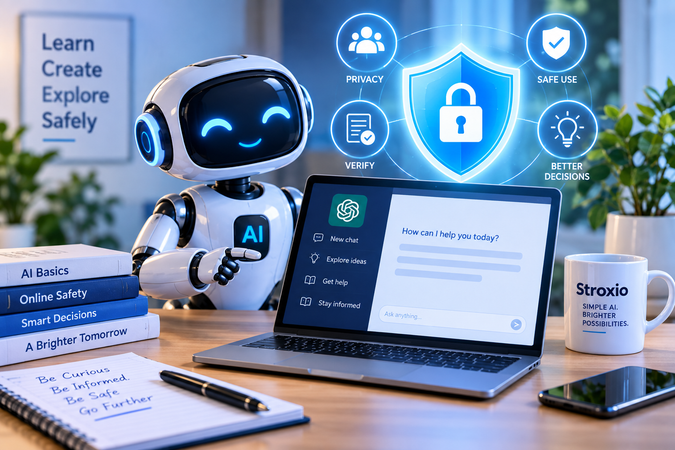
Artificial intelligence can be incredibly useful, but using it wisely means understanding a few basic safety rules. AI tools can help you learn, create, research, and solve problems, but they can also make mistakes, provide inaccurate information, or encourage you to share information that should remain private.
The good news is that you do not need to be a technology expert to use AI safely. A few simple habits can make a significant difference.
In this lesson, you’ll learn how to protect your personal information, recognize unreliable AI-generated content, verify important answers, and make smarter decisions when working with AI. By the end, you’ll have a practical set of safety habits you can use whenever you interact with an AI tool.
Why AI Safety Matters
AI can respond so naturally that it is easy to assume everything it says is accurate or trustworthy. But AI does not understand information in the same way a person does. It generates responses based on patterns in the information it has learned from, and sometimes those responses can be incomplete, outdated, misleading, or simply wrong.
Safety also involves what you give to AI. Personal details, passwords, financial information, confidential work documents, and other sensitive information should be treated carefully when using any online AI service.
Learning these limitations does not mean you should be afraid of AI. It means knowing when to trust it for everyday assistance, when to double-check an answer, and when certain information should never be shared in the first place.
Stroxio’s Insight
Think of AI as a knowledgeable assistant—not an unquestionable authority. The more important the information is, the more important it is to verify it.
Protect Your Personal Information
One of the most important rules when using AI is to be careful about the information you share. It can be tempting to give an AI tool lots of details because more context can sometimes produce a better answer. But not every detail belongs in an AI conversation.
Avoid entering passwords, Social Security numbers, banking or credit card information, private identification numbers, or other highly sensitive personal information into an AI prompt.
The same principle applies to information about other people. Before sharing someone else’s private details, confidential business information, or documents containing sensitive data, consider whether the AI actually needs that information to help you.
A useful habit is to ask yourself: “Would I be comfortable if this information were stored outside my computer?” If the answer is no, leave it out or replace it with general information.
Stroxio’s Insight
Good AI safety starts before you press Enter. Share only the information the AI actually needs to answer your question.
Don’t Assume Every AI Answer Is Correct
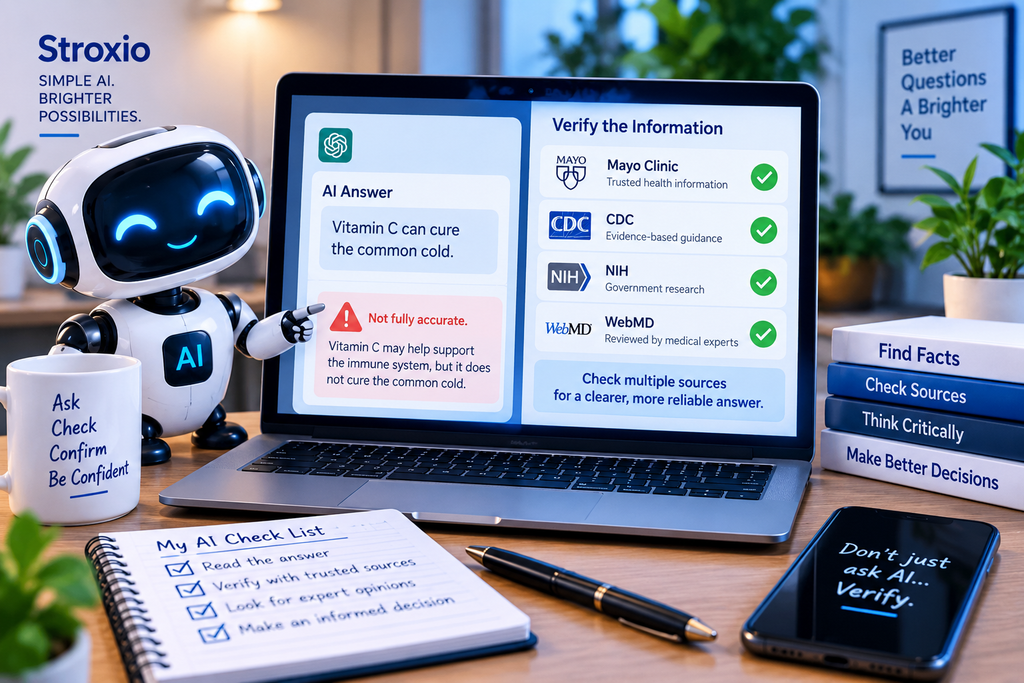
AI can produce answers that sound confident and convincing even when the information is inaccurate. These incorrect or invented responses are sometimes called AI hallucinations.
This is especially important when you are using AI for topics such as health, finances, legal matters, current events, or important decisions. An AI response can be a useful starting point, but important facts should be checked against reliable sources.
When possible, look for the original source of the information. Compare important claims with trusted websites, official organizations, established publications, or qualified professionals when appropriate.
Also pay attention to dates. AI-generated information may not always reflect the latest developments, so information that was once correct may no longer be current.
Stroxio’s Insight
Confidence is not proof of accuracy. If an AI answer could affect your health, money, safety, or an important decision, verify the information before acting on it.
Watch for AI-Generated Misinformation
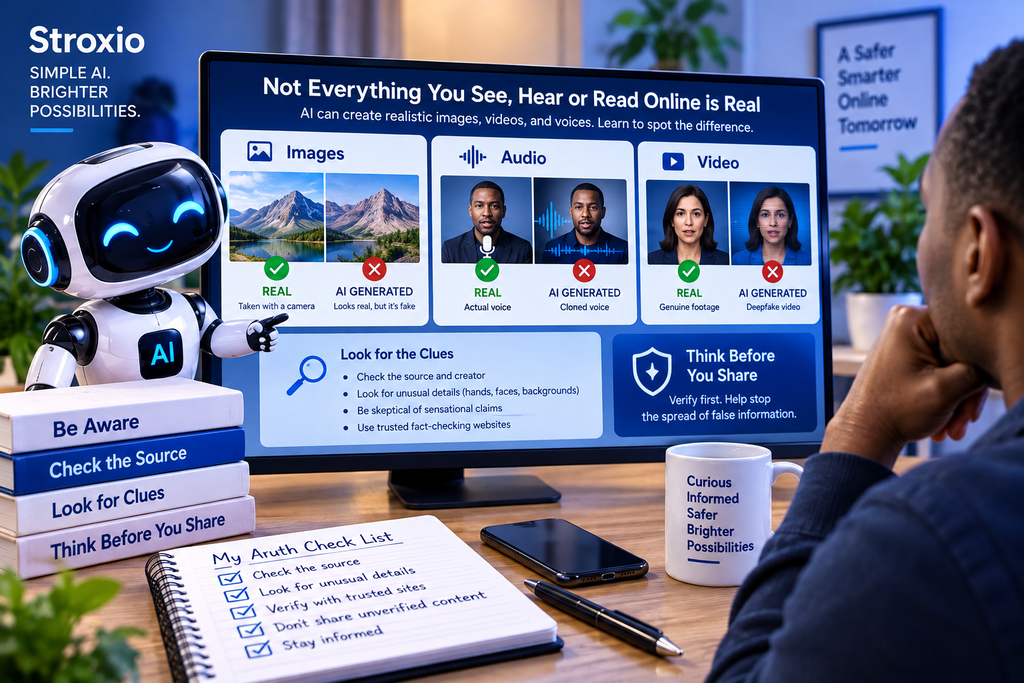
AI can create realistic-looking text, images, audio, and video. While these tools have many useful applications, they can also make false or misleading information appear convincing.
For example, an image may look like a real photograph even though it was completely generated by AI. A video or audio recording may appear to show a real person saying something they never actually said. These types of manipulated media are often referred to as deepfakes.
Before believing or sharing surprising content, check where it came from. Look for confirmation from reliable sources, examine whether the original source can be identified, and be cautious when a post is designed to provoke an immediate emotional reaction.
A simple rule can help: pause, check, then share. Taking a few moments to verify something can prevent false information from spreading further.
Be Careful When Following AI Advice
can explain complicated subjects, suggest possible solutions, and help you understand your options. However, there are situations where an AI response should not replace advice from a qualified professional.
This is particularly important with medical, legal, financial, and safety-related matters. AI may help you prepare questions, understand terminology, or organize information, but important decisions in these areas may require professional guidance.
The level of verification should match the importance of the decision. Asking AI for dinner ideas carries very little risk. Making a major financial or health decision based solely on an AI response could have much greater consequences.
A useful way to think about AI is as a starting point for understanding—not always the final authority for deciding.
Use AI Responsibly
AI safety is not only about protecting yourself. It is also about considering how your use of AI may affect other people.
Understanding how AI models work can also help you use these tools more thoughtfully.
AI can help you write, brainstorm, create images, summarize information, and complete many other tasks. But using AI responsibly means avoiding harmful or deceptive uses, respecting other people’s privacy, and being transparent about AI-generated material when the situation calls for it.
It is also important to keep your own judgment involved. Instead of allowing AI to make every decision for you, use it to explore ideas, consider alternatives, and improve your understanding.
The goal is not simply to use AI more often. The goal is to use it thoughtfully, safely, and with good judgment.
Build Your AI Safety Habit
You do not need to memorize complicated rules to use AI safely. What matters most is developing a few habits that become automatic whenever you use an AI tool.
Before sharing information, consider whether it is private or sensitive. Before accepting an important answer, verify it. Before sharing AI-generated content, check whether it is accurate. And before acting on high-stakes advice, consider whether professional expertise is needed.
These simple habits allow you to enjoy the benefits of AI while reducing unnecessary risks. As AI becomes a larger part of everyday life, knowing how to use it safely will become just as important as knowing how to use it effectively.
Challenge
The next time you use an AI tool, practice the pause, check, then act habit. Before submitting your prompt, check that you have not included unnecessary personal or sensitive information. When you receive the answer, choose one important claim and verify it using a reliable source.
This simple exercise will help turn AI safety from something you merely understand into something you practice automatically.
Key Takeaways
- Protect your privacy: Never share passwords, financial details, identification numbers, or unnecessary sensitive information with an AI tool.
- Verify important information: AI can sound confident even when its answer is incorrect.
- Check before you share: AI-generated images, audio, video, and text can sometimes spread misinformation.
- Know when expertise matters: Medical, legal, financial, and other high-stakes decisions may require qualified professional guidance.
- Keep human judgment involved: Use AI to support your thinking—not to replace it.
- Pause, check, then act: A few simple safety habits can make AI much safer and more useful.
Want to better understand the AI terminology behind privacy, safety, and responsible AI use? Explore our beginner-friendly guide, AI Terms Every Beginner Should Know, for simple explanations of essential AI concepts.
Lesson Complete
You now understand the basic habits that can help you use AI more safely and responsibly. You know how to protect sensitive information, question AI-generated answers, recognize potential misinformation, and decide when human expertise is necessary.
AI safety is not about avoiding AI. It is about using these powerful tools with awareness, responsibility, and good judgment.
Continue Your Journey
Now that you know how to use AI more safely and responsibly, the next step is looking ahead at where this technology may be going.
Your next lesson is:
AF-010 — The Future of Artificial Intelligence
In AF-010, you’ll explore how artificial intelligence may develop in the years ahead, where it could become part of everyday life, and how to separate realistic possibilities from speculation.
One lesson. One challenge. One step forward.