
In the previous lesson, we explored how generative AI creates new content. Now we’ll look at one of the key technologies that helps make modern AI possible: machine learning.
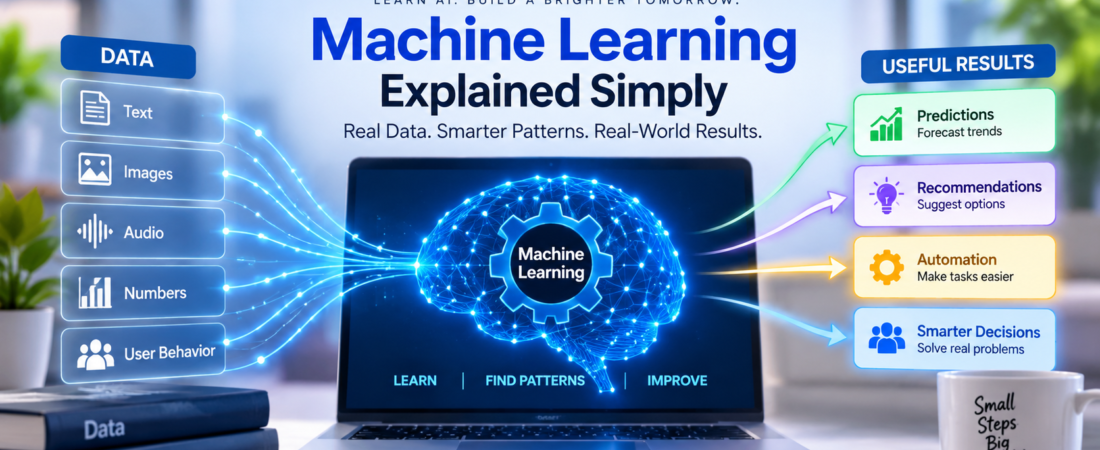
Machine learning is one of the most important ideas behind modern artificial intelligence. It helps computers recognize patterns, make predictions, and improve at certain tasks by learning from data rather than relying only on fixed instructions.
You encounter machine learning more often than you may realize. It helps email services detect spam, streaming platforms recommend movies, navigation apps estimate travel times, and AI tools understand patterns in text, images, and other information.
In this lesson, you’ll learn what machine learning is, how it learns from data, the basic ways machine learning systems are trained, and why this technology plays such an important role in artificial intelligence today.
By the end of this lesson, you won’t need to understand complicated mathematics or programming. Instead, you’ll have a practical understanding of how machines learn from examples and how that learning allows AI systems to make useful decisions.
What Is Machine Learning?
Machine learning is a way of teaching computers to recognize patterns in data and use those patterns to make predictions or decisions.
Instead of giving a computer a detailed rule for every possible situation, we provide it with examples. The computer analyzes those examples, identifies useful patterns, and builds a model it can use when it encounters new information.
Think of it like learning to recognize a dog. You probably didn’t learn by memorizing a long list of rules about ears, tails, fur, and body shape. You saw many dogs over time and gradually learned the patterns that distinguish dogs from other animals.
Machine learning works in a similar way. It learns from examples rather than relying entirely on instructions written in advance.
How Machine Learning Learns from Data
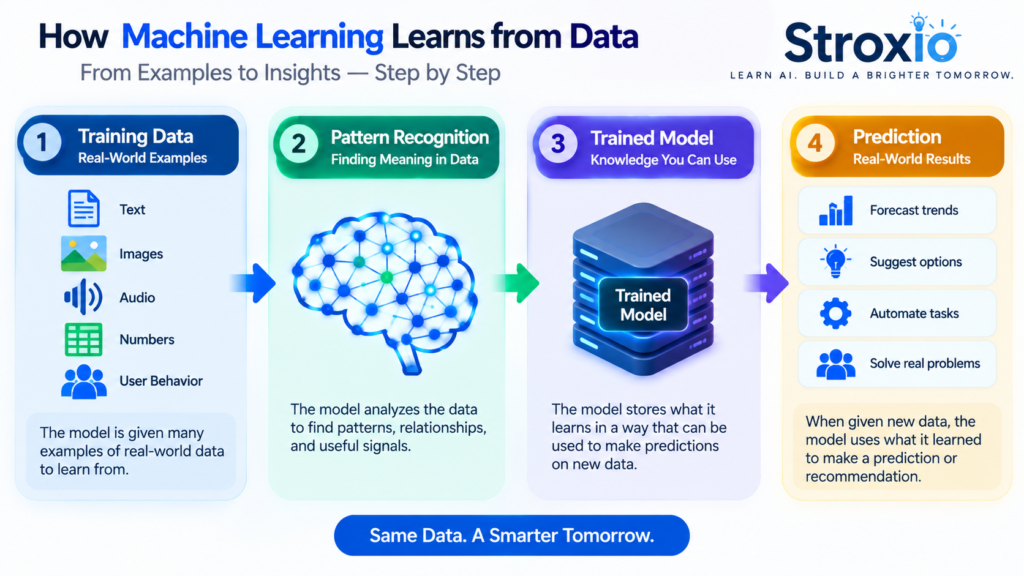
Data is the foundation of machine learning. A machine learning system needs examples it can study before it can recognize patterns or make useful predictions.
Imagine teaching a computer to distinguish between pictures of cats and dogs. You could give it thousands of labeled images showing which animals are cats and which are dogs. During training, the system examines characteristics in those images and begins identifying patterns associated with each animal.
When the system is later shown an image it has never seen before, it uses the patterns it learned during training to predict whether the image contains a cat or a dog.
The prediction may not always be correct. When the system makes mistakes, its model can be adjusted during training so that future predictions become more accurate. This process of learning from examples, measuring errors, and making adjustments is at the heart of machine learning.
Stroxio’s Insight
Think of training data as experience for a machine. The more relevant examples a model encounters during training, the more opportunities it has to recognize useful patterns.
But experience alone isn’t enough. Just as learning from poor examples can lead a person in the wrong direction, a machine learning model can learn misleading patterns from poor-quality data.
Three Main Types of Machine Learning
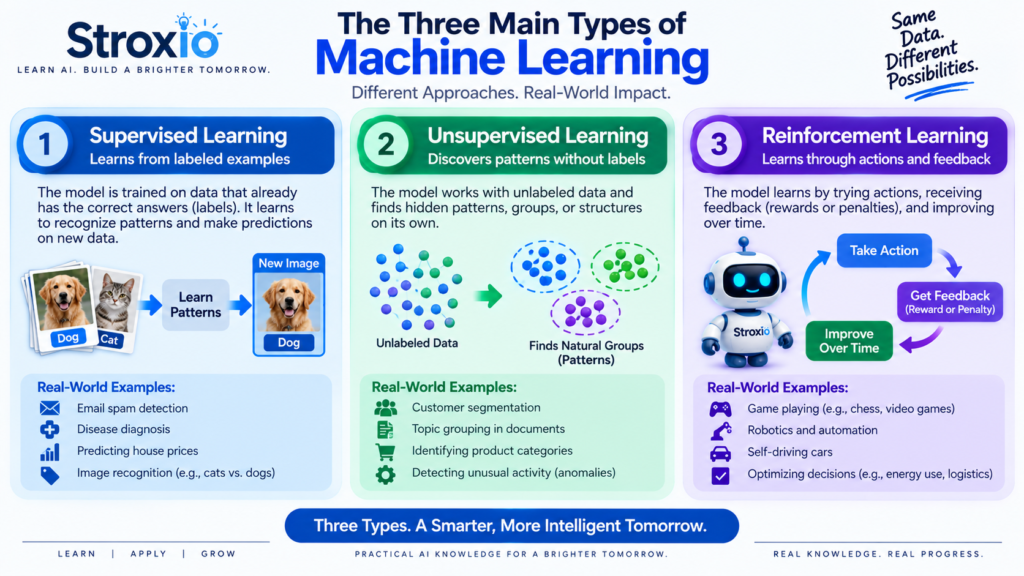
Machine learning can be approached in different ways depending on the type of data available and what we want the system to learn. Three of the most common approaches are supervised learning, unsupervised learning, and reinforcement learning.
Each approach teaches a machine differently. Understanding these three basic types will make it easier to see how machine learning is used in real-world AI systems.
1. Supervised Learning
Supervised learning uses examples that already include the correct answers. These examples are called labeled data.
For instance, imagine showing a machine learning system thousands of emails labeled either “spam” or “not spam.” The system studies characteristics of both groups and learns patterns that help distinguish unwanted messages from legitimate ones.
Once trained, the system can examine a new email and predict which category it belongs to.
Supervised learning is commonly used for tasks such as recognizing images, detecting spam, predicting prices, and classifying information.
2. Unsupervised Learning
Unsupervised learning works with data that does not come with predefined labels or correct answers. Instead, the system examines the data and looks for patterns, similarities, or groups on its own.
Imagine giving a machine learning system information about thousands of shoppers without telling it how those shoppers should be categorized. The system might discover that certain people have similar purchasing habits and automatically group them together.
Businesses can use patterns like these to better understand customer behavior, identify trends, and organize large amounts of information.
Unsupervised learning is especially useful when we have plenty of data but do not already know what patterns may be hidden inside it.
3. Reinforcement Learning
Reinforcement learning teaches a system through actions, feedback, and consequences. Instead of learning from a collection of correct answers, the system learns by trying different actions and observing what happens.
Think of teaching a computer to play a game. At first, it may make many poor moves. Actions that lead to better results receive positive feedback, while actions that lead to poor results receive less favorable feedback. Over time, the system learns which choices are more likely to produce a successful outcome.
This approach can be useful when an AI system must make a sequence of decisions and learn from the results of those decisions.
Reinforcement learning has been applied to areas such as robotics, game-playing systems, resource management, and other problems where an AI must learn which actions work best through repeated experience.
Why Training Data Matters
A machine learning system can only learn from the information it is given. That makes the quality of training data extremely important.
If the data is accurate, varied, and representative of the situations the system will encounter, the model has a better chance of producing useful results. But if the training data is incomplete, inaccurate, or heavily biased toward certain examples, the system may learn patterns that lead to unreliable results.
For example, imagine training an image-recognition system to identify different types of birds. If nearly all of the training images show birds photographed during daylight, the system might struggle when asked to identify birds in darker conditions.
This is why developers pay close attention not only to how much data they have, but also to its quality and how well it represents the problem they are trying to solve.
More data does not automatically mean better AI. Better data often matters more.
Stroxio’s Insight
When an AI system produces a surprising result, it’s tempting to focus only on the answer. But sometimes the better question is: What did this system learn from?
The quality and variety of training data can strongly influence what a model learns. Understanding that connection helps you evaluate AI results more thoughtfully instead of treating every output as equally reliable.
Training vs. Using a Machine Learning Model
It helps to separate two important stages of machine learning: training and using the trained model.
During training, the system studies data, identifies patterns, measures its errors, and adjusts the model. Depending on the complexity of the task and the amount of data involved, this process can require significant computing power and time.
Once training is complete, the model can receive new information and use what it learned to produce an output. This is often called inference.
For example, an image-recognition model might be trained using thousands or millions of images. Later, when you upload a new image, the trained model analyzes it and makes a prediction based on patterns learned during training.
A simple way to remember the difference is:
Training = learning from examples.
Inference = using what was learned.
Machine Learning in Everyday Life
Machine learning may sound highly technical, but you probably interact with it every day without thinking about it.
When a streaming service recommends a movie, a navigation app predicts traffic, or an email service filters suspicious messages, machine learning may be helping analyze patterns and produce those results.
Other common applications include voice recognition, fraud detection, product recommendations, search results, image recognition, translation, and personalized content.
These systems are not “thinking” in the same way a person does. They are using mathematical models to identify patterns in data and generate outputs based on what they learned during training.
Understanding this distinction is important. Machine learning can be extremely useful, but its results still depend on the data, training process, model design, and context in which it is used.
What Machine Learning Cannot Do
Machine learning can identify patterns and make impressive predictions, but that does not mean it understands information the way a human does.
A model can produce an answer that appears confident even when the answer is incomplete or incorrect. It may also struggle when it encounters situations that are very different from the data used during training.
Machine learning systems do not automatically know whether their outputs are fair, appropriate, or sensible in a particular situation. Human judgment is still important, especially when AI is used for decisions that can significantly affect people.
This is one reason responsible AI use involves checking important information rather than assuming that every AI-generated result is correct.
The goal is not to distrust machine learning. It is to understand both its capabilities and its limitations so you can use AI more effectively.
Stroxio’s Insight
Machine learning is less about giving a computer all the answers and more about giving it enough useful examples to discover patterns.
That distinction matters. When you understand that an AI model learned from data rather than simply being programmed with every possible answer, its strengths—and its mistakes—begin to make much more sense.
Challenge
Choose one machine learning system you encounter in everyday life. It could be a recommendation system, spam filter, navigation app, voice assistant, image-recognition tool, or another example.
Then answer these three questions:
1. What kind of data might the system learn from?
2. What pattern or prediction is it trying to make?
3. What could cause its prediction or recommendation to be wrong?
You do not need technical answers. The goal is simply to start thinking about AI in terms of data, patterns, training, and predictions.
Once you can identify those four ideas in a familiar technology, you are already beginning to understand how machine learning works.
Key Takeaways
- Machine learning allows computers to learn patterns from data rather than relying only on fixed instructions.
- Supervised learning learns from labeled examples, while unsupervised learning searches for patterns in unlabeled data.
- Reinforcement learning learns through actions, feedback, and consequences.
- Training data matters. Poor-quality or unrepresentative data can lead to unreliable results.
- Training and inference are different. Training is the learning process; inference is using the trained model to produce an output.
- Machine learning systems can be powerful, but their predictions are not automatically correct or appropriate.
- Understanding the relationship between data, patterns, training, and predictions makes it easier to understand how many modern AI systems work.
Want to better understand terms like training data, models, and inference? Explore our beginner-friendly guide, AI Terms Every Beginner Should Know, for simple explanations and practical examples that make machine learning easier to understand.
Lesson Complete
You now understand the basic idea behind machine learning: computers can learn patterns from data and use those patterns to make predictions or decisions.
You’ve also learned the difference between supervised, unsupervised, and reinforcement learning; why training data matters; and the difference between training a model and using that model to generate an output.
You don’t need to become a machine learning engineer to benefit from this knowledge. Understanding these fundamentals gives you a stronger foundation for recognizing what AI systems are doing, where their capabilities come from, and why their results sometimes need to be questioned.
That foundation will become increasingly useful as we continue exploring how modern AI works.
Continue Your Journey
You now understand how machine learning uses data to recognize patterns, make predictions, and improve at specific tasks. But as AI becomes more familiar, it is also important to separate what these systems can actually do from some of the myths surrounding them.
Your next lesson is:
AF-008 —AI Myths Explained
In the next lesson, you’ll examine some of the most common misconceptions about artificial intelligence and learn how to separate AI reality from exaggeration, fear, and hype, so you can approach artificial intelligence with clearer expectations and greater confidence.
One lesson. One challenge. One step forward.