
Artificial intelligence comes with its own vocabulary. Terms like machine learning, algorithm, prompt, and large language model can make AI sound far more complicated than it really is.
The good news is that you do not need a technical background to understand these terms. Once you know what the most common AI words mean, it becomes much easier to follow tutorials, explore AI tools, and understand what those tools are actually doing.
In this lesson, we’ll break down the AI terms every beginner should know using simple explanations and practical examples—without unnecessary technical jargon.
In This Lesson
By the end of this lesson, you’ll understand the most common terms used in artificial intelligence and be able to recognize them when exploring AI tools, reading tutorials, or learning more about how AI works.
- Artificial Intelligence (AI)
- Machine Learning
- Algorithm
- AI Model
- Training Data
- Prompt
- Language Model (LLM)
- Generative AI
- Hallucination
- Tokens
- Context Window
Artificial Intelligence (AI)
Artificial intelligence, or AI, refers to computer systems designed to perform tasks that normally require some form of human intelligence. These tasks can include understanding language, recognizing patterns, generating images, making predictions, and solving problems.
AI does not think or understand the world exactly as a person does. Instead, it uses data, mathematical patterns, and trained models to produce outputs based on the information it receives.
Simple example: When ChatGPT responds to a question, it is using artificial intelligence to process your prompt and generate a response.
Machine Learning
Machine learning is a branch of artificial intelligence that allows computer systems to learn patterns from data rather than being given explicit instructions for every possible situation.
During training, a machine learning system analyzes many examples and adjusts itself based on patterns it finds. It can then use those learned patterns to make predictions or produce results when it encounters new information.
Simple example: An email service can learn patterns associated with unwanted messages and use those patterns to identify new emails that are likely to be spam.
Stroxio’s Insight
Think of AI as the bigger picture and machine learning as one way of achieving it. These are two of the AI terms every beginner should know, because understanding the difference makes many other AI concepts easier to follow. Machine learning allows many modern AI tools to improve their performance by finding useful patterns in data.
Algorithm
An algorithm is a set of instructions or rules a computer follows to process information and perform a task.
In artificial intelligence, algorithms help systems analyze data, identify patterns, make calculations, and learn during the training process. You can think of an algorithm as part of the method the computer uses to determine what to do with the information it receives.
Simple example: A recommendation system may use algorithms to analyze what you have watched or clicked and determine which videos or products to suggest next.
AI Model
An AI model is a system that has been trained on data so it can recognize patterns and produce outputs when given new information.
The model is the result of the training process. Once trained, it can use what it learned to perform tasks such as generating text, recognizing images, making predictions, or answering questions.
Simple example: ChatGPT uses trained AI models to process your prompt and generate a response based on patterns learned during training.
Training Data
Training data is the information used to help an AI model learn patterns during the training process.
Depending on the type of AI system, training data may include text, images, audio, numbers, code, or other forms of information. The quality, variety, and relevance of this data can influence how well the resulting model performs.
Training data does not mean the AI simply stores every example and retrieves it later. Training changes the model so it can use learned patterns when processing new inputs.
Simple example: An AI system designed to recognize objects in photographs may be trained using many examples of images containing different objects.
Prompt
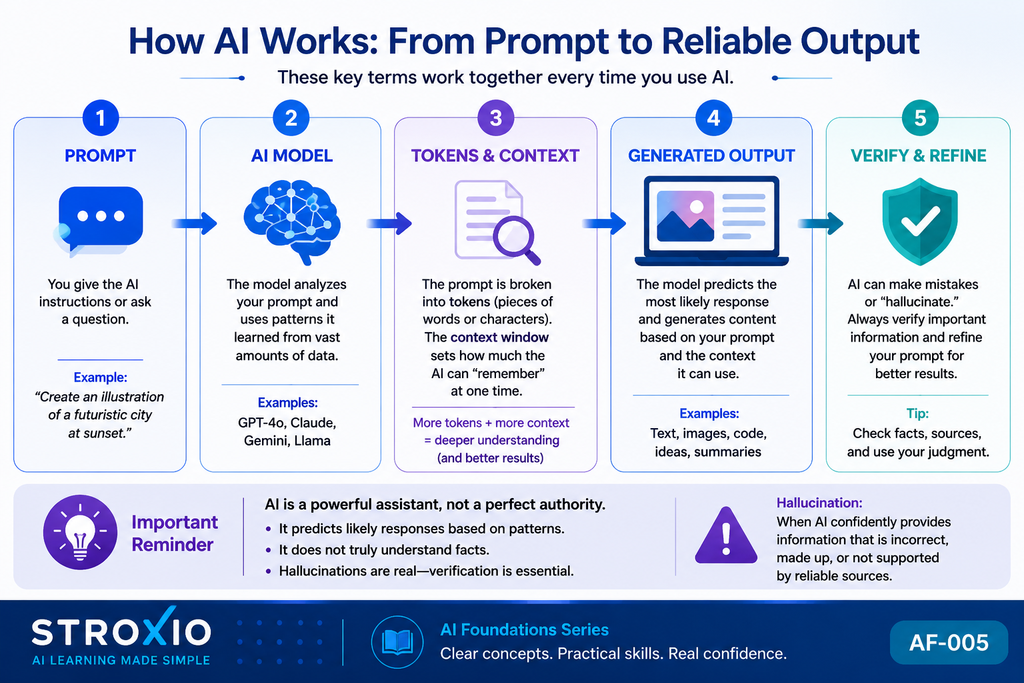
A prompt is the instruction, question, or information you give an AI system to tell it what you want it to do.
Prompts can be very simple or highly detailed. In general, providing clear context, specific instructions, and the desired outcome helps an AI tool understand what kind of response you are looking for.
Learning how to write effective prompts is one of the most practical skills you can develop when working with generative AI.
Simple example: Instead of asking ChatGPT, “Write about exercise,” you could prompt it with, “Give me five beginner-friendly exercises that can be done at home without equipment.”
Stroxio’s Insight
The quality of an AI response often begins with the quality of the prompt. You don’t need complicated instructions—start by clearly explaining what you want, provide useful context, and tell the AI what a good result should look like. Better prompts usually lead to more useful results.
Large Language Model (LLM)
A large language model, often shortened to LLM, is an AI model trained to work with language. It learns patterns and relationships in large amounts of text so it can process and generate language.
LLMs can perform tasks such as answering questions, summarizing information, drafting content, explaining concepts, translating text, and helping with ideas.
An LLM does not understand language in exactly the same way a human does. It generates responses by using patterns learned during training and the context provided in your prompt.
Simple example: When you ask ChatGPT to explain a difficult subject in simple language, an LLM processes your prompt and generates a response based on the context and patterns it has learned.
Generative AI
Generative AI refers to artificial intelligence systems designed to create new content based on patterns learned during training.
Depending on the tool, generative AI can produce text, images, audio, video, computer code, and other types of content. The user usually provides a prompt, and the AI generates an output based on that instruction and the capabilities of its model.
Generative AI does not simply search for and copy a finished answer. It generates an output based on learned patterns, although its responses can still contain errors and should be reviewed when accuracy matters.
Simple example: Asking an AI image generator to create an illustration of a futuristic city is an example of using generative AI to produce new content.
Hallucination
In artificial intelligence, a hallucination occurs when an AI system generates information that sounds convincing but is inaccurate, unsupported, or completely made up.
This can happen because generative AI is designed to produce a likely response based on patterns rather than independently verify every statement as fact.
Hallucinations are one reason you should verify important AI-generated information, especially names, dates, statistics, quotations, sources, and information that could affect an important decision.
Simple example: ChatGPT might confidently provide the title of a research study that sounds legitimate even though that particular study does not actually exist.
Tokens
Tokens are small units of text that language models use when processing and generating language.
A token may represent a whole word, part of a word, punctuation, or another small piece of text. AI models process prompts and generate responses using tokens rather than simply counting words.
Token limits can affect how much information an AI model can process at one time, which becomes especially important when working with long documents or lengthy conversations.
Simple example: A sentence containing ten words does not necessarily contain exactly ten tokens because some words may be divided into smaller pieces.
Context Window
A context window is the amount of information an AI model can consider at one time while processing a conversation or request.
The context can include your current prompt, earlier parts of a conversation, uploaded or provided information, and the AI’s previous responses. Different AI models can support different context-window sizes.
When a conversation or document becomes larger than the model’s available context window, some earlier information may no longer be available for the model to consider. This is one reason important instructions sometimes need to be repeated or summarized during very long interactions.
Simple example: If you give an AI a long document and ask questions about it, the model needs enough context capacity to process the relevant parts of that document along with your instructions.
Stroxio Challenge: Speak the Language of AI
Choose three AI terms from this lesson that were new to you or that you understand better now.
For each term, explain what it means in your own words. Then think of one real-world example of where you might encounter that term while using an AI tool.
EThe goal is not to memorize technical definitions. It is to become comfortable enough with AI vocabulary that you can recognize these terms and understand what they mean when you see them.
Stroxio’s Insight
AI can sound confident even when its answer is wrong. That’s why understanding hallucinations, tokens, and context windows matters in everyday use. When information is important, verify it rather than assuming a confident response is accurate. Knowing these limits helps you use AI with better judgment.
Key Takeaways: AI Terms Every Beginner Should Know
- AI terminology becomes easier once you connect each term to a practical example.
- AI models learn patterns from training data and use those patterns to generate outputs.
- Prompts are the instructions you give an AI system, and clearer prompts usually lead to more useful responses.
- Generative AI can create new content, but its outputs can still contain hallucinations or inaccuracies.
- Understanding tokens and context windows helps explain why AI tools have limits when working with long conversations or documents.
- You do not need to memorize every AI term—understanding the basic concepts gives you a strong foundation for learning more.
Want to see how these AI concepts work together? Continue with our beginner-friendly lesson, How AI Models Work, to discover how data, training, models, and inputs produce AI results.
Lesson Complete
You now understand some of the most important terms used in artificial intelligence. More importantly, you know what these terms mean in practical situations rather than simply recognizing their definitions.
As you continue learning about AI, you will see these words again and again. Each time you encounter them, they should feel a little more familiar—and that familiarity will make it easier to understand new tools, concepts, and possibilities.
Continue Your Journey
You now have a working understanding of the essential terms used in artificial intelligence. The next step is exploring one of the most important areas of modern AI—generative AI.
In the next lesson, you’ll explore generative AI—what it is, how it creates new content, and why tools like ChatGPT have made this type of artificial intelligence so widely used.
Your next lesson is:
AF-006 —Generative AI Explained
You’ll learn what generative AI is, how it differs from other types of artificial intelligence, and how it can create text, images, audio, and other forms of new content.
One lesson. One challenge. One step forward.